
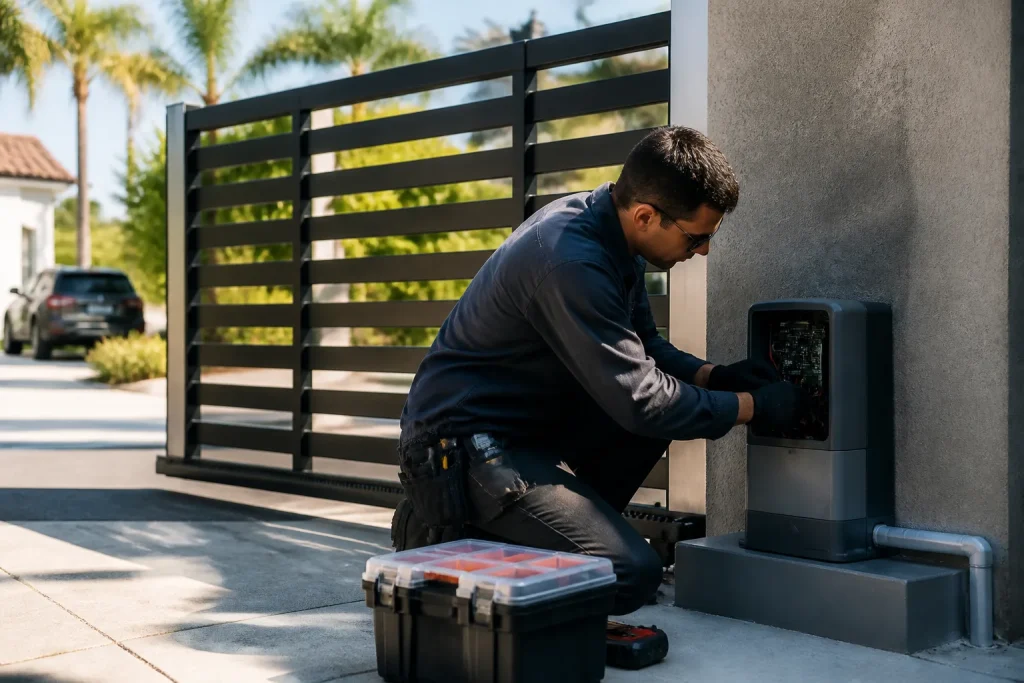
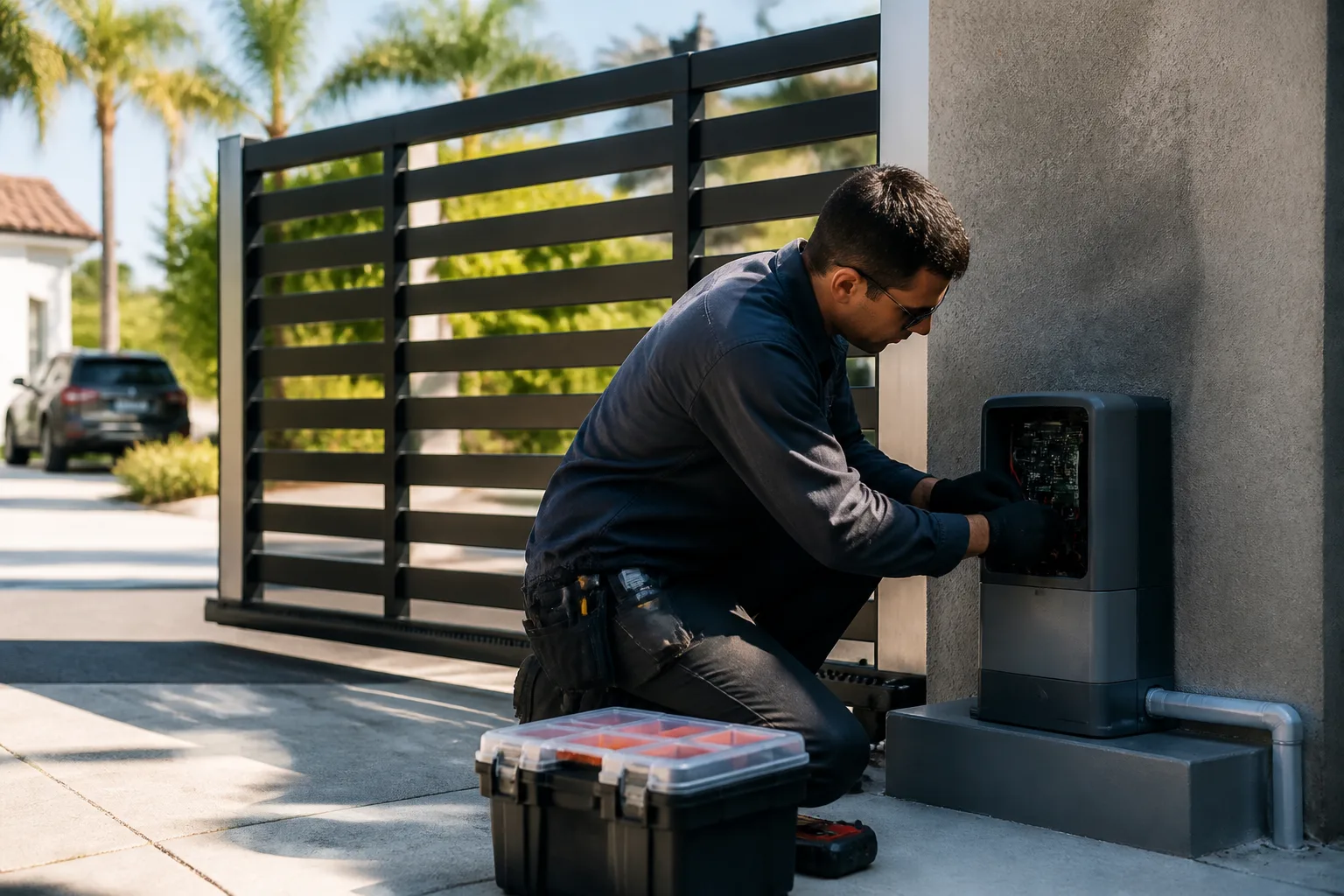
BFT Gate Repair in Anaheim: A Homeowner’s Guide
BFT gate repair in Anaheim usually comes down to one of four things: an encoder misreading, a BUS wiring fault, a capacitor that’s given up in the heat, or a board that’s actually fine but getting blamed for all three. Most BFT operators don’t need a new control board, even when the fault code suggests otherwise. If you’d rather skip the diagnosis and just get it fixed, call (833) 734-5599 and we’ll sort it out. Otherwise, here’s what’s actually going wrong inside your BFT operator.
Why BFT Operators Confuse Generic Gate Technicians
BFT builds their operators differently than most American brands. Where a LiftMaster or Linear swing gate typically uses physical limit switches that tell the motor “you’ve reached the end, stop now,” BFT uses an encoder-based positioning system. The encoder tracks motor shaft rotation and calculates gate position from that data. It’s precise, it’s smooth, and it’s also the reason so many BFT systems in Anaheim get misdiagnosed.
Here’s what we mean. When a limit-switch operator drifts out of position, you adjust the switch or replace it. When a BFT operator drifts, the encoder recalibrates on its own, usually after a full open-close cycle. But if the gate hits something during that cycle, a wind gust catches it, or the hinge drag increases in summer heat, the encoder logs a fault. A technician who’s never worked on BFT systems sees the fault code, assumes the control board is bad, and quotes you $400 to $600 for a part you don’t need. We’ve pulled perfectly good BFT boards out of gates in Anaheim Hills and East Anaheim where the real problem was a worn hinge causing encoder trip-outs.
This is why brand-specific knowledge matters. The diagnostic logic for a BFT operator runs backward from what most gate techs learned on American brands, and that misunderstanding costs homeowners real money. We work on BFT gates, and eight other major brands, which means we’re not locked into one manufacturer’s playbook when we’re trying to figure out what’s wrong. Your gate is the only thing we fix. That’s the whole business.
The BFT Fault Codes Anaheim Homeowners See Most
Let’s talk about what those blinking codes on your BFT control board actually mean. Because in Anaheim’s climate, some of them show up for reasons that have nothing to do with the part the manual points to.
E1 and E2: Encoder and Position Faults
An E1 fault means the encoder isn’t reading correctly. It can be a failed encoder, but in our experience across Anaheim, it’s usually a thermal issue. BFT operators are built in Italy, and while they’re engineered for heat, the sustained 90-plus degree days we get from June through October push the encoder’s tolerances. The sensor expands, the reading drifts, and the board throws an E1. The fix is often a recalibration and checking the gate’s physical movement, not replacing a board. An E2 fault signals the gate moved when it wasn’t commanded to, or didn’t complete a commanded move. That one’s frequently wind-related. Anaheim gets those strong Santa Ana gusts through the fall, and a solid- panel swing gate acts like a sail. The operator fights the wind, the encoder gets confused, and you get an E2.
E3: Current Overload
E3 means the motor is drawing too much current. Before you authorize a motor replacement, here’s what we check first: hinge wear, gate weight distribution, and the capacitor. In Anaheim’s older neighborhoods, the Colony and the areas around Pearson Park, we see gate posts that have shifted over decades, putting the gate out of square. The motor works harder, draws more current, and trips E3. Replacing the motor without fixing the alignment just burns out the next motor too. The capacitor is another E3 culprit that gets overlooked. It’s a $30 part. We’ve diagnosed E3 faults where a technician quoted a full motor swap, and the only problem was a capacitor that lost its ability to hold a charge in the heat.
E5: Obstacle Detected
This is the one that started this guide. An E5 on a BFT operator in Anaheim often isn’t an obstacle at all. The encoder-based obstacle detection works by monitoring how much the motor has to work against expected resistance. When the gate’s metal components expand in direct sun, the hinge tolerance tightens, the resistance changes, and the system thinks something’s in the way. On a Phobos or Deimos operator, we’ve seen E5 faults every afternoon that disappear overnight when the gate cools down. The solution is recalibrating the encoder’s force profile for the heat, not replacing the board or the motor.
BFT’s 2-Wire BUS System: The Hidden Fault Generator
BFT uses a proprietary 2-wire BUS protocol to connect accessories, keypads, safety beams, and photocells to the operator. It’s elegant, it reduces wiring clutter, and it’s also the single biggest source of “ghost problems” we see on BFT gates in Anaheim.
Here’s the issue. Because everything shares one two-conductor line, a single damaged wire, a corroded splice, or a failing accessory anywhere on that BUS can create faults that look like operator failures. Your gate stops responding to the remote. The safety beam stops working. The board throws an error that points nowhere specific. An untrained technician starts replacing parts, the board, the receiver, the remote, and the problem persists because the actual fault is a nicked wire underground or a photocell that got water in it during an Anaheim rain event.
We diagnose BUS problems by isolating accessories one at a time, testing continuity, and checking terminations. It’s slower than swapping boards, but it’s also how you actually fix a BFT instead of temporarily masking a wiring fault. If your BFT gate has worked fine for years and suddenly starts acting erratically across multiple functions, remote, keypad, beams, suspect the BUS before you suspect the operator.
BFT Parts Availability in Southern California: What to Expect in 2026
This matters because when your gate is stuck, you want it fixed today, not in three weeks. Here’s the reality of BFT parts in the Anaheim area right now.
Common replacement parts, capacitors, photocells, keypads, remotes, and some limit assemblies, are generally available from distributors in the Los Angeles and Orange County area within one to three business days. Control boards for the more popular current models like the Phobos, Deimos, and Aries lines are usually stockable in three to five days. Motor units and gearboxes are a different story. Those typically come from BFT’s North American warehouse, and depending on the model, you’re looking at seven to fourteen days even with expedited shipping. For older BFT models or discontinued lines, a motor replacement can stretch to three weeks or longer.
There’s a practical takeaway here. If your BFT operator is throwing encoder or current faults, we usually recommend starting with the diagnostic and the lower-cost fixes first. A capacitor, a wiring repair, or a recalibration is often all you need, and those parts are available now. If you do need a motor, you’ll want to know that upfront so you can plan around the lead time rather than discovering it after you’ve paid for a board replacement that didn’t solve the problem.
BFT Warranty Coverage: What’s Actually Covered and What Voids It
Before you authorize any repair on a BFT operator in Anaheim, you should know what the warranty does and doesn’t cover, because the line between the two is where homeowners get burned.
BFT’s standard warranty covers manufacturing defects in the operator and its components for a limited period from the date of installation, typically two to three years depending on the product line and when it was purchased. But the key phrase is manufacturing defects. A board that fails because of a soldering flaw is covered. A board that fails because a power surge hit it during a Santa Ana wind event, or because the gate was operated with damaged hinges for six months, is not.
Here’s what voids a BFT warranty fast: any repair or modification performed by someone who isn’t authorized to work on BFT equipment, using non-BFT replacement parts, failing to install required safety devices like photocells and edges, or operating the system with known mechanical problems. We’ve had Anaheim homeowners come to us after a handyman “fixed” their BFT with a generic part and voided the remaining warranty in the process. The operator failed again a month later, and now the repair is entirely out of pocket.
The practical rule is this: if your BFT operator is still under warranty, call a company that’s actually fluent in BFT systems before you let anyone open the panel. If it’s out of warranty, you still want someone who understands the brand, because the correct repair is still cheaper than the wrong one twice. For a full breakdown of what’s involved in getting your gate working again, our Gate Repair in Anaheim page covers the process from diagnosis to done.
When to Call a Pro on a BFT Gate
Some BFT repairs are genuinely doable for a capable homeowner. Replacing a remote, swapping a photocell, resetting a tripped breaker, those are straightforward. But here’s where we draw the line, and it’s a safety line, not a sales line.
Anything involving the motor, the gearbox, the encoder, the BUS wiring, or the control board should be handled by someone who works on BFT systems regularly. The high-tension components in a gate operator can cause serious injury if they release unexpectedly. The electrical work inside a BFT panel carries real risk too. And the diagnostic complexity, as we’ve covered, means a homeowner without BFT-specific training is more likely to misdiagnose the problem than to fix it. If your BFT gate is under warranty, a professional repair protects that coverage. If it’s out of warranty, a professional repair protects your time and your gate. For electric and automated systems, our Electric Gate Repair in Anaheim page explains exactly what we check and how we fix it.
If you’re considering replacing the operator entirely rather than repairing it, our Gate Installation in Anaheim page covers what a full BFT installation includes. And if you’re weighing BFT against other brands like LiftMaster or FAAC, we can help you make that call honestly, because we work on all of them. That’s the benefit of a multi-brand shop. We’re not going to push you toward a brand because it’s the only one we sell. We’re going to tell you what actually makes sense for your gate, your driveway, and your Anaheim weather conditions.
The Bottom Line
BFT gate repair in Anaheim is a different animal than generic gate repair. The encoder-based positioning, the 2-wire BUS, and the thermal behavior of these operators all mean that a fault code is the beginning of the diagnosis, not the end. The most common mistake we see is a control board replacement for a problem that was actually a capacitor, a wiring fault, or a heat-related calibration issue. Before you authorize any BFT repair, understand what the fault code means, check whether your warranty still applies, and confirm that whoever’s diagnosing it actually works on BFT systems regularly. If you’re in Anaheim and you need a BFT specialist, First Light Gate Repair offers free estimates. Call (833) 734-5599 and we’ll diagnose it correctly the first time.
Frequently Asked Questions
BFT gate repair in Anaheim typically runs between $150 and $650 depending on the fault. Minor fixes like capacitor replacement or encoder recalibration usually land in the $150 to $250 range. BUS wiring repairs and photocell replacements typically run $250 to $400. Control board replacement on a BFT Phobos or Deimos generally runs $450 to $650 including parts and labor. Motor and gearbox replacement starts around $700 and can exceed $1,200 depending on the model. Every job gets a written, agreed quote before any work starts. Call (833) 734-5599 for an exact price on your specific fault.
Common BFT repairs like capacitor replacement, encoder recalibration, and photocell or keypad fixes can often be completed same-day in Anaheim, especially if the needed part is in stock locally. Motor replacements and some control board replacements depend on parts availability, which can run three to fourteen days as covered above. Call (833) 734-5599 and we’ll give you a realistic timeline based on your model and fault.
Yes. BFT is one of nine gate brands we work on regularly, alongside LiftMaster, FAAC, Linear, and others. Our technicians are trained on BFT’s encoder-based positioning systems, BUS wiring architecture, and specific fault codes, which means we diagnose BFT operators correctly rather than treating them like a generic swing gate.
That depends on the motor’s condition and the model’s age. If the control board is current, the motor runs smooth, and the fault is a capacitor, wiring issue, or calibration problem, repair is almost always worth it. If the motor itself has failed on a model that’s been discontinued, replacement is often the better long-term play once you factor in parts lead times. We’ll give you the honest answer either way, because we’re not attached to selling you a new operator if your existing one has years left in it.
Written by the team at First Light Gate Repair, serving Anaheim since 2014.
Need Gate Repair Help?
Call First Light Gate Repair — licensed & insured, here with fast after-hours help in Anaheim.
(833) 734-5599